Saturday, July 18, 2015

Macedonian MUN

A few weekends ago on June 27, Macedonia hosted its Model United Nations Conference for the youth of Macedonia.  Macedonian MUN is a secondary project for PCVs, and executing this event was the first major task for me (as my absence from this blog reflects) for what appears to be a pretty busy summer.

Organizing this conference with the local NGO was anything but an easy process.  As I mentioned in a previous post, financing the event was a major issue, but many other small yet persistent problems made the preparations for this project very arduous. 


However, once the delegates arrived, the conference took a life of its own, and the delegates seemed to really enjoy discuss international affairs and foreign diplomacy with students from other cities in Macedonia.  The striking difference for this conference was the participation of a team from Kosovo.  Earlier in the year, we were contacted by a PCV from Kosovo who had discovered our MUN conference and asked if his team could participate.  Charles, the PCV, trained his team well, and the delegates seemed to have no issues with competing with the Macedonian delegates.

[Note, all photos posted below are taken from the Coalition SEGA Facebook Page]

Opening Ceremony

Speech by Peace Corps Director Cory


PCV Charles and one of the teams from Kosovo

PCV Coordinators


Monday, July 6, 2015

Matka Canyon

A few of the past posts were pretty word/ link heavy, so I will change things up a bit by posting mainly pictures.  A few weekends ago, I took a quick trip to Ohrid to hike Matka.  The canyon is located about an hour bus ride from Skopje, and it is also hike-able from the Millennium Cross on top of Vodno.  The hike along the canyon is pleasant, though we hiked for quite some time before discovering that maybe the footpath along the water did not lead anywhere.  Otherwise, hiking the canyon through the shade of the forest was a pleasant respite from Skopje's summer heat.  And there were so many butterflies!


Wednesday, July 1, 2015

Reception of Refugees: Done Right

During the first months of arriving to service, I wondered to myself, “How far away is Syria from Macedonia?”  Obviously, both countries were once part of the Ottoman Empire, but mountains, seas, and national borders made the two countries seem worlds apart.  To get a better sense of the distance, I did a Google Map measurement  based on the fastest route by driving and discovered that the distance between Skopje and Damascus is roughly the same as the distance between Chicago and Miami. 

For most of my service, Macedonia was not much involved with the conflict in Syria.  However, much of that changed once refugees started fleeing towards Europe.  As many who keep up with the news know, the stem of refugees increased over the past year, likely due to many reasons.  The civil war in Libya intensified, ISIS added to the threats in Syria, and countries like Italy and Greece attempted to minimize the flow of refugees to their shores by turning away boats or destroying barges at bay in Libya.  Thus, many refugees are finding alternative routes to Europe, through places like Turkey, Bulgaria, and now Macedonia.

For many of these refugees, Germany or the Scandinavian countries are their final destination.  Not only do they seek shelter from a war-torn country, but they also hope for economic prosperity in a prospering capitalistic democracy.  As this news article shows, even after leaving Syria and arriving at the border of Macedonia, refugees face the threat of mafia robbing them of their only assets and police detaining or deporting them.

However, this article lacks a clear account of what the refugees may have gone through while traveling through Macedonia, most likely because the government and people in this country have done many things to make the refugees’ transition through less daunting.  Until recently, many migrants snuck through Macedonia by walking along the train tracks, which run along the Vardar river north toward Skopje and Kumanovo.  However, in the past few years, many travelers had died along that route.  So a new route had emerged that is much safer for these refugees: biking along the highways toward Kumanovo. 

As this article describes, refugees are allowed by the Macedonian government to flee through the country on bicycles.  Some locals are taking advantage of this method by selling bicycles at exorbitant prices to these refugees.  However, a few NGOs, including Red Cross in Negotino, are aiding the refugees by donating un-used bicycles, food, water, and other supplies.  Some of the campers who will be attending our YMLP camp are supporting such projects in their town.

However, recently Macedonia’s politicians passed a law that allows migrants to stay in Macedonia for up to 72 hours, before they are deported or seek asylum.  This law permits them to use public transportation, including buses and trains, so many of these migrants no longer need to bike or walk across the country.  Traveling to Skopje a few weeks ago, I was surprised to see so many bikers along the highway.  My last trip to Skopje, just this past weekend for the MUN conference, had fewer migrants, so it seems that the law is working.

Overall, the Macedonian government’s response to the migrants and the people’s reaction to them is very commendable.  As far as I know, not many other countries in Europe treat the migrants with such dignity.  Of course, Macedonia’s stance on these migrants is not completely selfless- Macedonia knows that none of the migrants want to stay in Macedonia, but are heading for Central or Western Europe.  However, Macedonia makes part of the journey easier and much safer for a group of people who are simply seeking for a future and chance to live.  Many Macedonian youth have expressed to me their interest in leaving Macedonia to find a better future in Western countries.  It is nice to know that many Macedonians have empathy for those also seeking a different life abroad.  This hospitality compares to Hungary’s response, which has contemplated in building a 110-mile fence along the border with Serbia.

To get a sense of the tide of refugees from Syria and the overall EU response, take a look at this website’s depiction.


Tuesday, June 30, 2015

Something a Little More Modern

Since I posted a few classic songs to this blog, I would be short-sticking Macedonia if I did not add a few songs that are a bit more contemporary.

Of course, popular songs produced by Macedonian artists reflected the popular styles of music over the past few decades.  Based on my conversation with others, Macedonia and the rest of Yugoslavia had a golden age of music during the 1980s with plenty of rock hits.  One of my favorite bands from the 1980s-1990s era is Kuku Lele (songs will be hyper-linked throughout this post), which I was lucky to hear at a wine festival this past October.

One of the things I was surprised to discover is that Macedonians seem to really enjoy Ska.  Ska songs are typically played a few times on the radio, and at Pivo Fest last year there was a ska band that played.  One of our local bands, the Hounds, also regularly covers a Ska version of "Take on Me."  The first Macedonian song that I really enjoyed upon my arrival was Africa by Superhiks, which is a tribute to the Roma people and their struggle in this country.

So based on the last post, some of you may wonder, what is Turbo Folk?  As I mentioned, most of the popular Turbo Folk songs originate from Serbia, as this random search on Youtube shows.  However, the problem for us Americans is that any pop Serbian song with a beat sounds like Turbo Folk to us.  One of the reasons why clubs in Macedonia aren't the most entertaining for foreigners is that Serbian pop songs by artists like Ceca and Severina are played late at night.  When we do not understand the language, all of the Serbian pop songs sound the same, and most Macedonian youth don't break out in dance when the songs play, but rather just sing along.

But Macedonia has released some very artistic songs in the past few years.  Karolina Goceva reminds me of a Norah Jones with a Macedonian twist. 

Finally, no blog post about modern Macedonian hits would be complete without a small shout-out to Tose Proeski.  Tose was a huge Macedonian star who was popular throughout the Balkans.  Born in Prilep, he later moved to Krusevo (where his museum stands).  He is of Vlach origin, and his songs are sung in many languages, including Serbian, English, and even one in Roma.  Unfortunately, at the height of his career, he was killed in a motor accident while traveling in Croatia.  Since then, many Macedonians idolize him.  To us Americans, it seemed very strange that so many people worshiped him with pictures hanging in shops and hanging from rear view mirrors, etc. (Some may remember the woman I met in Veles during PST who had his picture everywhere in her office, including next to an icon of Jesus and Mary).  An American can only think of comparing this idolization to Kurt Cobain or Whitney Houston.  However, Tose rose to prominence about a decade from Macedonia's independence, and given all of the struggles that Macedonia faced to that point, his fame may have given hope to a country which by some countries will not even be recognized by its name.  Tose was also a very giving celebrity, dedicating much of his time to charity and fighting for various causes.  Since then, no Macedonian singer has experienced the same prominence throughout the world. 

Thursday, June 18, 2015

Народна Музика


Sometimes when I go to Bitola, we have a Жежо (Žežo) night.  Жежо is a kafana, or classic Macedonian restaurant, that caters mainly to Macedonian men.  Thus, frequenting this kafana is equivalent to a men’s night out, with rakija, salads, and kebabs.  Luckily, many weekend nights also feature a duo that plays Macedonian folk music on a keyboard and sometimes saxophone, which completes the whole experience.

One of the main cultural reflections of any people or country is its music, and yet many PC volunteers fail to write a substantial account of the local music.  I assume that the reason for this is that Macedonian folk music is not their cup of tea, or at least they do not take the necessary legwork to download and create a playlist for these songs.  For the longest time, I have urged my counterparts and Macedonian friends to send me a list of Macedonian songs so that I can listen to them and become acquainted with the music.  However, the Macedonian folk music never really sunk in until I attended these two recent weddings, despite my general proclivity towards Macedonian folk music.

Background of Balkan Music
According to P. Manuel’s Popular Musics of the Non-Western World, Balkan music from most of former Yugoslavia (especially that from Macedonia, Serbia, Montenegro, and Bosnia, since these countries were ruled much longer by the Ottomans than Croatia) share similar characteristics adapted from the Ottoman culture.  Popular instruments used in Ottoman, and thus Balkan, folk music include the gajda (similar to a bagpipe), a large drum carried at one’s side, and a clarinet-like instrument.  Of course, folk bands have adapted to more modern instruments, including the clarinet, the accordion, and the saxophone.  Singing is often vibrato, and the rhythm of a song can either be free-flow, or 2+2+2+3, similar to many popular Turkish folk songs.

Besides being played in kafanas, Macedonian folk songs are also played at weddings and larger cultural events, including slavas.  In regards to the themes of the songs, they are not often very complicated, but instead appeal to the core of anyone’s soul.  For example, lyrics often lament one’s hometown/ land, a love that was lost or that is longed for.  Therefore, these songs make for excellent drinking songs, and many Macedonians belt their voices in unison when they sing them.

According to my host brother, Macedonian folk music is recently experiencing resurgence, since many young people in the Balkans previously turned to Turbo Folk, or basically a Balkan version of electronic pop music.  Supposedly Turbo Folk (which is said with much disgust on people’s faces nowadays) became popular during the civil war in the 1990s because soldiers wanted something simple and easy to listen to.  Although many Macedonian folk songs have deep historical roots, many modern singers are making a name for themselves by adopting them and singing them professionally.

Provided below are a list of a few Macedonian folk songs and Youtube links with their modern performance. 

Odi Zvezdo (Naum Petreski) 
Ete Majko Resiv da se Zenam (Vojo Stojanovski)
Leno Mori (Aneta I Mollika) 
Ti Samo Ti (Marjan Kocev I Drim Tim)  (During this song, us PCVs usually point at each other when we sing, “Ti, ti, ti, samo ti”, which means “You, you, you, only you”)

Finally, I am providing the Youtube link and the lyrics for my favorite Macedonian folk song, Tugja si bez Krajno (Efto Pupinovski) 

Нашата света куќа
Нашето огниште
Тука си бевме среќни
Тука си растевме

И нашето дрво расте
На старото скришно место
Кај што се љубевме
И наеднаш се' ќе згасне
И летото ќе се смири
Кавал ќе засвири

[REFRAINX2]
Ааа...за една судбина
Оној што силно љуби мора да губи
Туѓа си бескрајно

Оној што сега молчи
Ќе биде осамен
Оној
што сега плаче
Вечно ќе тагува

Исплачи се сега мила
Исплачи се така сама
На мојте рамена
И наеднаш се' ќе згасне
И летото ќе се смири
Кавал ќе засвири

[REFRAINX2]

TRANSLATION (roughly by me)
Our sacred home
Our hearth
There we were happy
There we grew

And our tree grew
By that secret place
Where we made love
And suddenly everything will end
And summer will wind down
The kaval (flute) will begin to play

[REFRAINX2]
Aaa… For one fate
He who loves strongly must lose
When you are away (another’s) it seems like eternity

He who is silent
Will be alone
He who now cries
Will eternally mourn

So cry yourself out, darling
Cry as you do
Into my shoulders
And suddenly everything will end
And summer will wind down
The kaval (flute) will begin to play

[REFRAINX2]

Thursday, June 11, 2015

Wedding Season

It doesn’t take long on a sunny afternoon day to realize that it is wedding season.  Sitting in my flat with my balcony open, or walking down the streets of Prilep on the weekend, the day seems to be interrupted frequently by the honking of horns along the road.  Non-stop wailing of those car horns.  They notify the rest of the town, “this girl’s taken.”

Weddings are rare in Macedonia most other times of the year, but after Easter, they seem to happen every hour.  Bows tied along fences and doors of houses are further reminders that love has been officiated.  And they seem to remain there forever- my neighbors still haven't taken the bows down from their fence.  This year, I not only attended my first Macedonian wedding, but I attended two in one week.  Although the weddings share similar elements to that of Western (American) weddings, they also had their own unique traditions that reflect Macedonia’s unique history.

The first wedding that I attended took place in a swanky hotel in Veles.  My host brother from PST, Aleksandar, was to be wed with his high school girlfriend, Kate.  As I mentioned in a previous post, they had lived together in an apartment in Skopje since November 2013, so it was only a matter of time before they tied the knot.  I rented a room of the hotel with Allison, another PCV who also had the Zarkovs as a host family.  The hotel, Gardenia Hotel and Spa, was absolutely beautiful, even though it was still being constructed.  I was completely surprised that there was a hotel like this in such a small town as Veles.  Although there were not many rooms, it seemed that the place generated most of its revenue from hosting events (weddings) and by drawing in crowds from Veles at night (the alcohol was cheap, while the food was a bit pricey).

Unfortunately, Allison and I did not participate in any of the cultural parts of the wedding.  But once she had finished getting ready (which for a girl, can take a couple of hours), we finally entered the ballroom.  It was amazing to see so many people from Lozovo all dressed up.  It seemed that half of the town was there, and we quickly greeted and hugged all of the folks that we had not seen since March.  Luckily we were placed with some of Jagoda’s family at a table near the dance floor, and we enjoyed the typical wedding fare, which included salad, cold cuts and cheese, a baked potato, and the dinner.  There was also an endless flow of alcohol, as half-liter bottles of beer were continuously brought to our table.  Allison, half of Lozovo, and I danced the oro through the rest of the night and shared conversations with our PST family and friends.

The couple cutting the cake

With the host family from Lozovo

Oro at a wedding
Photo Cred to Allison
The second wedding I attended occurred within a week of the first, and this one was closer to home.  My host cousin, Dijana, was to be wed to her long-time boyfriend.  My whole host family looked forward to this event, and my host brother even flew in from Poland in order to attend the wedding.  This time, I took part in all of the cultural activities of the wedding, as my host family included me as a part of their own through all of the stages. 

First, we waited next door at Dijana’s place for Sasho (the groom) and his party to arrive.  And boy did they arrive in style.  The cars pulled up honking, as a line of people oro’d to the front door, accompanied by a trio playing traditional music on their accordion, saxophone, and drum.  All of Sasho’s family sat down in the other room, eating snacks and drinking alcohol, as Sasho attempted to enter Dijana’s room to take her as his bride.  Her friends prevented him from entering until he could give them enough money to gain permission.  Once he gained permission to enter, he was then tasked to put shoes on her feet, which of course were too big and needed to be stuffed with even more money until she could wear them “comfortably”.  From there, we oro’d in what seemed a 9m2 room, and from there we made our way to the local church.

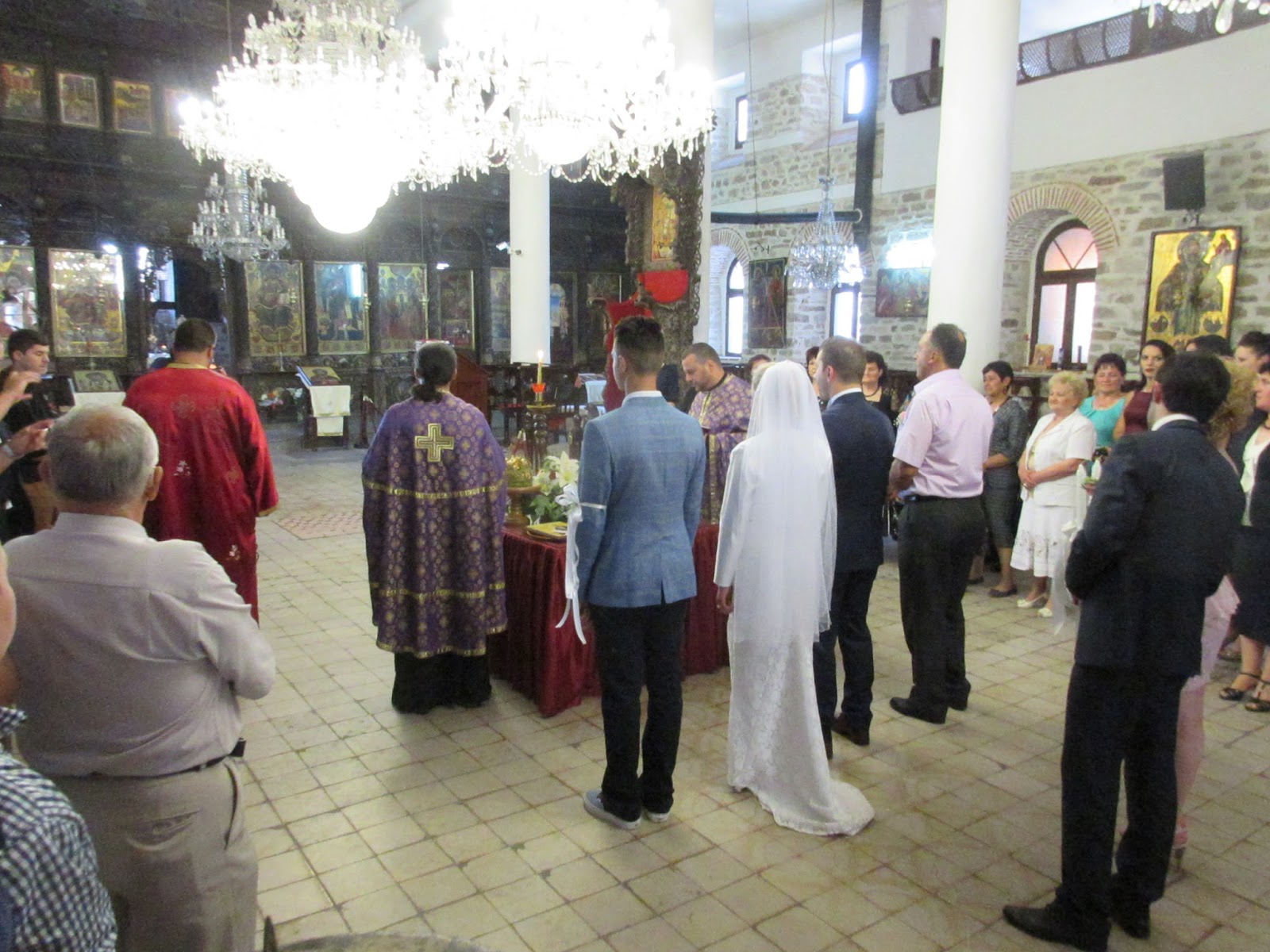
At the church, men were told to stand on one side, while the women were positioned on the other.  A few priests said a lot of words really fast, spitting the Word of God at the speed of Twista, and a few people lit candles and put ropes on the bride and groom.  Honestly, the ceremony looked like a conjugal baptism.  The only tradition I recognized was that pertaining to the crowns.  Eventually, Sasho and Dijana were donned crowns, and it was the best man’s job to switch their crowns three times without making the crowns collide.  Supposedly if the crowns touched each other at all during the process, fate would frown upon that marriage.  This tradition seemed like an unnecessary risk to take during a wedding ceremony.


We ended the night by dancing, eating, and drinking at a local hotel.  After, we all drove to the groom’s parents house where we sat, drank, and talked some more.  We did not return home until about 4.30AM, at which my host mother served us one last coffee before going to bed.  

*Addition*: Unfortunately, I did not film any of the reception of either wedding, but this Youtube video is a good depiction of what a Macedonian wedding is like (AND it is one of my favorite songs to oro to), https://www.youtube.com/watch?v=ULUtzFe2wac

 
The bride with some of the family


The groom's party making an entrance


Oro in closed quarters

At the church


With the host family from Prilep

More oro!

Wednesday, June 3, 2015

Recent Events in Macedonia

So I am finally catching up to the current time here in Macedonia, in regards to this blog.  Now that I am finished posting about my vacation, I may as well return the setting to Macedonia.

My travels through Central Europe were limited by my commitment to return to Skopje by May 10 for the Skopje marathon.  As readers of this blog know, I did not run the marathon last year due to shin splints.  Unfortunately, I did not run the marathon this year for very different reasons.

At around 4AM on Sunday, about 4 hours before the race, I received a text from one of my counterparts.  It basically said, "Sorry, but the race has officially been cancelled.  Check the news online."  The announcement prompted me to share this with other PCVs who were crashing in the same room.  It was a major bummer, and we had no idea what to do.  But with adrenaline and disappointment already pumping through us, a few of us decided to walk around the neighborhood and try to find alcohol for a morning run.  We couldn't find any, since we were in an Albanian neighborhood, so we decided to try to sleep a bit more just as the sun was beginning to rise.

Why was the marathon cancelled?  Well, it seemed that there was a "terrorist attack" in nearby Kumanovo.  Even weeks after the event occurred, the details are still fishy and not completely clear.  But the marathon was cancelled because, first, there were rumors that these terrorists from nearby Kosovo were targeting an attack on the marathon, and second, the day was quickly recognized as a day of mourning for the 8 police officers who lost their lives battling this group.

This article seems to sum up very nicely all points of this messy situation, and it reflects the opinion of a lot of the people here in Macedonia.  I cannot discuss politics of this country, so I will stop short of presenting any of my opinions, but you can devise your own after reading the article.

http://www.economist.com/news/europe/21651262-after-long-political-ferment-short-burst-fighting-danger-or-distraction

Since this incident, things have calmed down significantly in this country.  However, even though it was inconvenient that the marathon was cancelled, it seems on retrospect like the right call.  Many of us just feel bad that some foreigners traveled from far away to run a race that was eventually cancelled.  For example, one man from China was prepared to run his 100th marathon, and even arrived in Skopje early to accustom himself to the roads, air, and elevation.

A few PCVs managed a quick run around the city on Sunday, and the energy was electric.  A few runners managed to run a part of the course, and we saw them march past the official finish line chanting "Macedonia!  Macedonia!"  Despite not racing that day, it was a good day to be a runner.


Group of runners marching to the finish line (Photo taken from Skopski Marathon Official FB page)

PCVs (from Macedonia and Albania) enjoying our morning run