Monday, February 8, 2016

The COS Trip that Now Is Not

It's funny- before I embarked for Macedonia, even before I knew what my Peace Corps experience would entail, I had planned an element of my Close of Service (COS) trip.  My trip would end in the Philippines, where I would join my family for a set of reunions.  Many of these reunions would occur in January, and they would commemorate wedding anniversaries, my late grandmother's 100th birthday, and a reunion of my large extended family (I have 20+ cousins on my father's side).  However, with my 6 month extension, the tail end of my COS trip instead became just another international trip during my service. 

This was the second time that I had visited the Philippines, as I first visited the country during the summer of 2001.  Before I departed Macedonia, I was sick with a cold, and since my dinky heater is not capable of heating my whole apartment, I looked forward to being in a place where I was not constantly shivering.  Besides the excitement of seeing my family for the first time in about a year, I also anticipated  seeing my good friend, Ted, who would arrive in Manila from Japan on the same night as me. 

A Bit of a History Lesson
Last year, when I announced my plan to visit the Philippines to one of the Peace Corps doctors, she responded that of all the countries in the world, the Philippines reminds her the most of Macedonia.  Her reasoning: both countries were conquered by various empires through their histories and were between major transit zones in their regions, and thus the people of each country are conditioned accordingly.  In many ways, I agree with her statement, and I found the similarity between the Macedonian and Filipino concept of hospitality striking.

According to http://www.philippine-history.org, the Philippines was first subjugated by the Borneo sultanate.  Arab Muslims arrived in the southern parts of the Philippines around 1380, and the Muslim Malays loosely ruled the Philippines until Magellan first discovered the archipelago for Europe in 1521.  Spain continued to send expeditions to the Philippines (Philippines was named after the Spanish king, Philip II), and they ruled the islands for about 350 years.  Their major (or most enduring) contributions to the islands was the widespread conversion of the people to Catholicism (I cannot tell you how much Catholicism is part of Filipino culture), Spanish loan words in Tagalog (supposedly about 40% of Tagalog vocabulary is derived from Spanish cognates), and a stubbornly unequal social structure based on principalía, where large swathes of rural land is ruled by a tiny elite.

In the late 19th Century, insurrections against Spanish rule became frequent, the most famous of which were advocated through propaganda by Dr. Joseph Rizal.  Luckily, these movements for Filipino independence coincided with the decline of the Spanish Empire (from what I remember from my high school history class, the Spanish were still using wooden galleons at the time).  Additionally, the United States declared war on Spain in 1898, and by the end of the war Spain ceded the Philippines to the USA, along with other territories including Puerto Rico.  Sporadic Filipino independence movements continued, this time against the Americans, and in 1934 the United States passed the Tydings-McDuffie Act, which promised the independence of the Philippines by 1934.

However, hours after the Japanese invaded Pearl Harbor in 1941, the Japanese also invaded the Philippines.  General MacArthur initially retreated to Bataan, where the US and Filipino forces were able to hold off the Japanese for about 3 months.  Eventually, they surrendered to the Japanese, and the Allied forces were forced to march to San Fernando.  This forced movement, known historically as the Bataan Death March, resulted in thousands of casualties over a 5-day period.  Before their surrender, General MacArthur fled to the USA vowing to return to the Philippines to liberate it from the Japanese.  He returned in 1944, and shortly after the Philippines was liberated.

The Philippines was granted its independence on July 4, 1946, yet the fifth president of the Philippines, Macapagal, changed the official independence day to June 12 in commemoration of the Philippines' first declaration of independence from Spain in 1898.

Back in the East
Arriving at the Hong Kong airport for my last layover before landing in the Philippines, I realized how pleasantly familiar it was to be back in Asia.  Although I have come to enjoy the Balkan atmosphere and lifestyle, being surrounded by Asian merchandise, cuisine, and people elicits a feeling of childhood for me.  I arrived in Manila just before midnight, and after my father picked my friend Ted and me up, we drove to a restaurant (that was surprisingly open at 2AM) where I enjoyed pancit for the first time in over a year.  The first night we slept at my aunt's house in Quezon City, and although I awoke periodically through the night dripping in sweat, bitten by mosquitos, and often to a cacophony of dogs barking, roosters crowing, and tricycles lumbering over speed bumps, I relished sleeping in a warm room.  The next day, we picked up my brother from the airport and headed straight for the beach resort of Sabang.

My family and I stayed at a resort in Sabang 15 years previous as well, so our stay in the area felt familiar for me.  We took a ferry from Batangas and landed on the island on my birthday.  Unfortunately, we were all dogged from jet lag and waiting for my brother from 3AM to arrive in Manila, and so right after eating from room service, we decided to take a power nap, which turned into an early night of sleep.  However, the next day we mustered enough energy to hit the local beach town.  What I expected of the town was WAY different from the reality.  Recent travels in Europe has spoiled me into thinking that vacation hotspots attract young people from all over the globe.  Instead, this resort town was filled with older gentlemen (loosely termed) whose mission was to take advantage of the flourishing sex trade in the area.  15 years ago I was too young to take notice of how flagrantly open prostitutes catered to the foreign clientele, but I tried my best to ignore this element of the resort area and enjoy an otherwise tropical paradise.

View from our hotel room


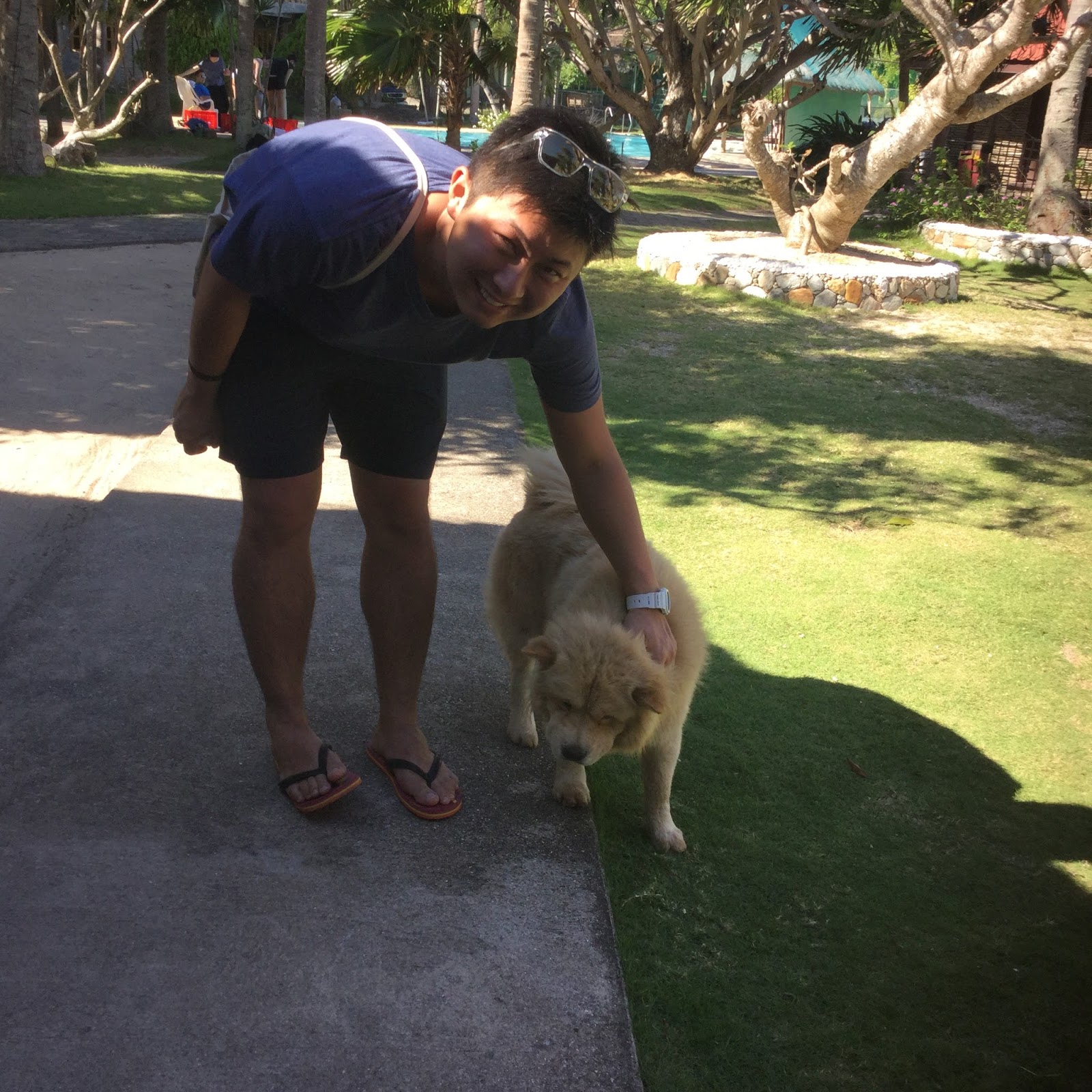
Afternoon nap with my beach buddy


Celebrating my birthday


Of course, on another day we rented a boat to tour the reefs and snorkel.  My last swim in the Filipino ocean resulted in my being stung by a jellyfish, so as soon as my brother spotted four jellyfish on our last swim stop, I capitulated and sat idle on the beach.  The best night of the whole trip was probably our final dinner on the island.  Ted, Mike, and I bought local produce and fresh fish from town, and we cooked a magnificent dinner on the hotel's grill.  Personally it was the culmination of reuniting with my father and brother as well as enjoying my final Peace Corps experience with Ted.  I even had the opportunity to clean and descale the fish (Lapo Lapo), which I first learned to do on the shores of Albania.

Some fresh prawns

Lapo Lapo


When we returned to Luzon, Ted very soon flew off to the USA, and the rest of us stayed in the capital for a few days.  Metro-Manila is supposedly the most densely populated urban center in the world (with 22 million inhabitants cramming around the bay), and thus traffic is a major issue in the metropolis.  There is also not much to do near my aunt's house, so we would often spend our afternoons in the air-conditioned mega-malls nearby.  Most of Manila was destroyed during World War 2, but we did manage to visit Fort Santagio (a Spanish fort that is one of the oldest buildings in the Philippines) near Manila's bay.  Additionally, I was able to reunite with Mareign, whom I had met last May in Belgrade, and she took us to the trendy food spot in Quezon City, where young people relaxed in a square surrounded by food trucks.  Curiously enough, I ordered from the Turkish food stall, and we dined on lahmacun and kebabs.


At Fort Santiago


Instead of visiting Baguio again (a mountain resort area in the North that we had visited during my first trip to the Philippines), we decided to visit Mt. Pinatubo so that my brother and I could do something a bit more active.  We arranged for a jeep to collect us from our hotel in Angeles, and after an amazing ride along a river that was filled with volcanic ash, we hiked for an hour into the mouth of the volcano.  Mt. Pinatubo was the second-largest eruption in the 20th century (according to our guide, the eruption was larger than that of Mt. St. Helens), and the eruption lasted 9 hours on June 15, 1991.  The American air force evacuated the nearby Clark airbase, and they never returned (the Philippines now operates the airbase).

The impact of the volcano was tremendous and widespread, as the eruption resulted in global temperatures falling over the next few years (much of the USA experienced some of its coldest winters in 1992 and 1993).  My aunt told me how ash was falling in Manila, and said that its reach went as far as Singapore and Malaysia.  Casualties may have remained low had not a tropical storm been passing through shortly after the eruption.  Our guide mentioned that many of the natives to the area (who look far more Austronesian than Filipinos) fled to caves instead of opting for evacuation, and they were all shortly burned or suffocated.  One of the benefits of the eruption was that it wiped out malaria-carrying mosquitos from the area.

Along the riverbed to Mt. Pinatubo


In the crater


Not only was the jeep ride to the volcano absolutely stunning, especially in the early morning light, but the hike up the mountain through the jungle fulfilled my Indiana Jones-like notion of hiking in the Philippines.  At the top, we enjoyed the views of the lake in the crater and refueled on a bit of chicken adobo before descending again.  Hiking to this volcano is a memory I will cherish for the rest of my life. 

Our final event on the agenda was the culminating event of the trip- commemorating the 100th birthday of my late grandmother.  We all congregated in Pangasinan, and we attended a mass that took place in the yard of my grandmother's childhood home.  It was great to be with family and feel connected again with my roots. 


My grandmother's childhood home in Mangaldan, Pangasinan
Walking around Pangasinan
At the commemorative mass at my grandmother's childhood home


Wednesday, December 30, 2015

On to the Next One

So I wanted to write one more post before the New Year, especially since I received feedback that my last few posts have been downers, to say the least.  I also want to clarify that the previous posts were in no way complaints about my current situation, and anyways I have more effective means of venting.  But given the age where we social media allows us to pick and choose how we share our lives, I want to make sure that I share the good and the bad, the glamorous and the ugly.  Painting only a positive picture of my Peace Corps experience would take the bite out of the "hardest job you'll ever love" reputation.

Here I am again, a day away from celebrating my favorite holiday and reflecting not only on the past year but on my whole Peace Corps experience.  It seems that my mind is stuck in a state of Peace Corps past, present, and future.  This whirlwind of mental time-traveling and emotions is so powerful now because 1) I am experiencing the third New Year's Eve while in Peace Corps and 2) my life is entering its biggest transition since I started this journey.   

Escaping the smog of Tetovo while exploring Krusevo during the holidays

On our way to see Star Wars
Part of entering this transition is the feeling that I do not know myself anymore.  For three years I lived with a lowered head and a mind engrossed in the whole Peace Corps experience that I have done little do reflect on who I am once I am removed from this setting.  This is "Peace Corps present".  These past years I have tried so hard to integrate and then make an impact that once I remove myself from this formula, I can no longer make sense of what my purpose will be once I return home and move on with my life. 

Enter "Peace Corps future."  As I finish my graduate school applications, investing my energy and hopes into potential scenarios of campuses and fellowships, I am in that uncomfortable limbo of waiting and letting fate decide my future.  One of the main reasons I extended was to continue to do something useful as I applied to graduate schools, but there is always a good chance that I will not be admitted, putting an end to my Plan A.  Thus life immediately after Peace Corps is completely fuzzy, but the remaining months are closing in fast.  In about a week, I will be traveling to the Philippines to celebrate a handful of important anniversaries with my family, and by the time I return I will have about three months remaining in Peace Corps.

Extending in a new city with a developing organization always meant that I would be working until my COS, but it is easy for me to compare these last three months to that of the fellow MAK18s who COS'd in October and November.  In other words, I find myself comparing my February to their August, starting a mental checklist of places I need to visit for the final time as a PCV, people I need to bid farewell, and of course the logistical necessities (medical, programmatic, etc.) required by Peace Corps before I leave. 

But looking to these final months puts me face-to-face with "Peace Corps past".  Reflecting on the past year, browsing through my Google Calendar, I notice how busy I was in Year 2.  I think about the initial feelings I experienced during my first months as a PCV.  I choke up a bit about the small things I used to do with PCVs that are no longer here, or with counterparts or host family members from which I will be an ocean away by this summer.  My own PST in Lozovo seems an unfathomable time away, and I really do not recognize that Chris anymore.  Thus I am brought back to the present, and this twirling whirlwind starts again.

Celebrating Christmas with the sitemates

Dave enjoying his new accordion
Yet what grounds me is this New Year, that I can compare today to exactly the two years previous.  And when the spinning stops, it is gratitude that I feel the most.  The biggest reason is that, for the past two years, my mind was wrapped in my father's health.  Last year I was back in Chicago preparing to donate my kidney (which due to complications, never happened).  Two years before, my father was still in the hospital.  This year he appears to be healthy, and I will see him again on our trip to the Philippines.

Aziz Ansari's final episode of "Master of None" reinforced my feelings of gratitude.  Without giving away too many spoilers, Aziz and his girlfriend eventually find themselves on a crossroad of either settling for what they have or taking one more attempt at pursuing their life passion.  I think I said it before, but this Peace Corps experience was all that I could ask for- everything I envisioned was practically realized.  My PST site, the site of my service, my host family, becoming the Finance coordinator for YMLP, applying for a SPA grant, working within a dual-culture community, becoming a CD trainer- these were all of the things I wanted to accomplish during my time in Peace Corps. 

And I feel fulfilled.  I was able to integrate into a culture and thrive professionally abroad.  I sacrificed almost three years of my youth to help people, and I do not regret it.  Now I know what this feeling is and that it makes me happy, and no matter what I do in the future, I have this sensation to gauge whether or not I am living a fulfilling life.


So "На здравје" to 2015, and may 2016 be an amazing year as well.

Tuesday, December 22, 2015

How's Tetovo?


This is easily one of the most annoying questions that I have been asked in the past month-and-a-half.  "How is Tetovo?"  Given that I am absolutely horrendous at small talk, this question is the embodiment of that dark art, yet so open that it makes every conversation awkward.  I compare this to what my former colleague once mentioned about the question "How was the honeymoon?"  The people who ask this question expect only a positive answer, and in the end they do not really care about the minutia about that trip.  And the same goes for "How is Tetovo?" which is why I consciously avoid asking the newly-sworn-in volunteers the same inane question regarding their new sites. 
This question is also annoying because potential responses may be a personal comparison of Prilep to Tetovo, which nobody cares about, or a description of my activities, which are bit of a struggle at this point.  So, in case anybody who reads this blog cares about what Tetovo is like or how moving to a new site upon an extension feels, I am providing an update of the most significant activities in the post below.

The New Batch
On 4 December, the newest group of volunteers in Macedonia, the MAK20s, officially swore in.  The ceremony was a formal event right in the center of Skopje.  The ceremony took me back to two years before, when the MAK18s were excited to step into our new roles as PCVs.  The most touching part of the ceremony was the Turkish ambassador's to Macedonia speech.  He was a late addition to the ceremony, as he tagged along with the American ambassador, and he recounted all of the PCVs that made an impact on his life when he was growing up in Turkey.

This ceremony was also a shift in my schedule, as my duties as a Community Economic Development trainer was finally coming to an end.  Overall, the experience was formative and reminded me how much I learned about community development through my time here.  While I could have always done more to be a better trainer (and of course, I was also limited by my work starting up AIESEC Tetovo), I enjoyed all that our CD was able to accomplish over the 11 weeks.  However, now that I am no longer required to be in Skopje on a weekly basis, I am enjoying my low-key lifestyle again. 

CD Trainers 
MAK20s after Swearing in
Throughout my whole service, I have tried to keep as many arms' lengths away from the PC staff as possible.  This has nothing to do with them- they really are an amazing staff and we are lucky to have them.  But I often prefer the Ron Paul style of PCVs, taking a more libertarian approach to my service here.  If I am struggling at site, my first reaction is not to contact Peace Corps but to figure it out and use local resources until the problem is solved.  Second, I just like feeling more isolated from the Peace Corps staff.  It was easier in Prilep when I was a 3-hour bus ride away from the office.  This preference is probably the only remnant of my original ideas about PC service.  It may just be my effort to feel like I am isolated in the bush in Africa and maximizing integration in order to contribute effectively.  Serving as a trainer definitely maximized my contact with the PC office, so I hope to stay off their radar until I COS in the spring.

Unfortunately, with the addition of the MAK20s , we are also losing our Country Director, Corey.  She has decided to leave early and return to the United States into retirement.  Everybody is very sad to see her go, and many of us believe that we hope in vain for the following PC Country Director to be just as great as she was.

Wishing Corey farewell!
The Grind
So here it is, an update on my effort to jumpstart AIESEC Tetovo.  Things are very slow, for many reasons.  After moving to Tetovo, I thought that I would finally be more flexible for work with the organization, since I now lived a short kombi-ride away from campus.  However, a handful of planned meetings and educations were thwarted by random Macedonian and Albanian holidays that kept presenting themselves at the last minute.  It always seems that nobody knows about a holiday until the day before, which makes prior planning and scheduling frustratingly difficult.  Also, the seminar that we planned to host in December fell through as the team that applied to run the project could not find a time to meet.  We are postponing the project until March, and I am continuing to keep my fingers crossed.

On the meetings were scheduled successfully, attendance continued to drop, which further demotivated me for my work here.  What makes this endeavor most difficult is that I am essentially working alone on all of the operations for AIESEC Tetovo.  When I proposed to help AIESEC Tetovo, I asked to specialize as a team leader for Talent Management, focusing on member development and recruitment.  However, my counterparts are essentially the leadership board in Skopje, and I have become the point person on all local operations in Tetovo, including external relations and marketing.  Most of all, I really miss having a team on campus on which I can rely and provide me with support, as was the case with AIESEC Prilep.  But we are opening applications for Vice Presidents of AIESEC Tetovo within the week, and if enough people apply then the organization will have a stronger body leading it. 

Thus, work in Tetovo has been slow and difficult.  For example, we have finally gained permission from the university to promote the internships to the students, but the request for a partnership with the Career Center was submitted about a month ago!  Yet, I have developed a rather solid disposition for being able to trudge through difficult times, which is helpful when work is slow.  Also, any free time I have in the office is dedicated to writing applications to graduate schools (which is another reason why I am not writing so much on this blog, since I am busy writing essays during other hours of the day).

Integrating Again
So yes, Tetovo is culturally different, which makes for at least some sort of a culture shock.  But the most impactful change of moving to this town is its size.  The estimated population of the Tetovo municipality (including the surrounding villages) is 120,000, or twice the size of Prilep.  Thus it is very difficult to meet people outside of work, and I feel less like I am making myself a home in Tetovo and more that I am just visiting the town temporarily for work (the latter of which is essentially true, but not necessarily enjoyable).

So I have fallen back on one of the most essential Peace Corps resources- the company of other PCVs.  A MAK19 with which I worked the past year through YMLP (Dave) recently moved a few houses down from me, which means that we often spend the dark, polluted Tetovo nights chilling at his place, often with other PCVs.  In the past month we have done plenty of nerdy things- one of which includes his creation of a Macedonian version of Risk.  In short, hanging out with PCVs on an almost-daily basis is a gigantic shift from my time in Prilep, where I would see my sitemates maybe once every two weeks or so.  My general absence from Americans in Prilep was due to being so occupied at night, either working out at the gym (I exercise in the mornings in Tetovo, since my gym here has a shower, and the shower at my apartment is virtually useless in the morning), or watching Turkish soap operas with my host mother.

AIESEC Tetovo Team Building
Risk Macedonia, created by Dave
Dave celebrating the holidays in Tetovo
Some of the few remaining MAK18s at Thanksgiving dinner
I do not regret spending so much time with Americans during the remaining months of my Peace Corps experience.  Living in Macedonia as a PCV is a major divergence from the American life typical for young professionals.  During my first two years of PC, I essentially lived at home (albeit on my own floor), changed my life to be more culturally appropriate, and focused on building relationships with HCNs in Macedonia.  With the end on the horizon, watching movies on a weeknight and cooking dinner with other Americans feels like I am regaining the chance to live the alternative lifestyle I may have lived if I had not joined Peace Corps.  And I continue to interact with as many locals as I can during the day.

Responding to such a short, open question like "How is Tetovo?" is anguish, but living here is not so bad.  In a few months, I will no longer live in this town, so I may as well enjoy the inquiry for a brief moment.

Wednesday, December 16, 2015

Trumping the Religion Card

First of all, I want to share a post published by Peace Corps in the Midwest.  It looks like I succeeded on getting my mother AND my host-mother on a Peace Corps publication!  I also had an article about the holidays published in the same media. 


Alright, on the main topic of this post which addresses that which was all over the news for the past week.  Trump wants to ban any foreign visitor who practices Islam from entering the United States.  Obviously that means that many refugees from the Middle East would be denied a haven in the USA, if Trump had his way.  It also means that Muslims from the Middle East and North Africa, from all over Sub-Saharan Africa, from Pakistan, from Bangladesh, from Indonesia, from Malaysia, from Turkey, Bosnia, and Albania, from Central Asian countries like Kazakhstan, Uzbekistan, Azerbaijan, minorities from Western China and the Southern Philippines and India etc. would not gain a right to apply for residency in the USA.  It would mean that foreign businessmen, tourists, family members would not be able to make important business meetings or see their loved ones in the USA.  His proposed policy obviously does not make sense.

Yet his proposed policy highlights an important issue- Islamophobia.  Islamophobia is starkly different in the United States and in Europe.  As a whole, it seems that our understanding of Islam is unfortunately painted by the September 11 terrorist attacks, as well as our war on terror primarily in Iraq and Afghanistan. In Europe, millions of refugees are fleeing through Turkey for haven in Northern Europe, where North African migrants are so prominent in Italy and France that these countries' European citizens feel that they are under cultural pressure from these ethnic groups. Contrary to how Americans see Islam, Europeans understand that Islam is a part of their history, and that it is not a distant, incomprehensible threat, but a way of life for millions across the Mediterranean. 

Like most people in the United States, I have never lived in a Muslim-majority community before joining the Peace Corps.  Thus my media played a big role in depicting how Muslims, compared to the typical American, were both different and the same across the globe.  I would try as best as I could to develop my idea of a Muslim people by basing my presumptions on the typical, Muslim-minority citizens within the United States.  However, this was flawed as well since these individuals were minorities differentiated by their traditions and faith, but nonetheless striving to integrate.

Not until recently have I lived in a place that was majority Muslim.  As many of you know, I have recently moved to Tetovo, which is estimated to comprise of 80% Albanians, almost all of which are Muslims.  Five times per day, I hear the call to prayer that bellows from the minarets.  There are cafes frequented by Albanians that do not serve alcohol.  I do not blink when I see a group of women wearing hijabs walking down the street.  Yet besides having to speak in Albanian when shopping, my life is basically unaltered from my previous two years in Peace Corps.  There is nothing inherently different from being Muslim.

I mentioned previously that Albanians and Macedonians, both coming from the Balkans and under the Ottoman rule for hundreds of years, have more in common than they would like to admit.  There are also many Muslim Macedonians (referred to as "Turks") and Muslim Roma who are regarded well despite the difference in religion.  Again, this is because the strife between many Albanians and Macedonians is a national issue, not a religious one.  It just happens to be the case that both nationalities also differ in terms of faith.

 So here is my point- being Muslim does not make somebody inherently different.  I work with plenty of Albanian youth who have the same ambitions as Macedonians of working in a professional internship abroad or who want to make a positive impact on their society.  If I do not feel alienated when I am surrounded by Muslim residents, then Americans should not feel threatened with a few families of Muslims in their midst. 


I am a Christian minority living in a Muslim-majority town.  That is something that I forget almost every single day, unless I force myself to remember it.  I believe that the majority of humankind has a set of beliefs that trumps religion and faith.  Belief in compassion, justice, democracy, fulfilling one's potential- these are a few of the values that often drive us more to be great individuals than religion.  Islamic State is preventing the rule of law under any of these ideals, and instead of fleeing to stable Arab states that otherwise are still autocratic and repress civil liberties, Muslim refugees are fleeing from Islamic State to Europe and the United States in the hope of living a fulfilling life.  They are fleeing tyranny under a skewed interpretation of a religion in order to live out a life in dignity.  And these are the same people that many political leaders and their supporters want to shut out.   The world's recent bout of Islamophobia is a reminder that it is surprisingly easier to build walls than it is to build institutions, tolerance, and understanding.