One of the things about my new site is that some of the PCVs
here are a bunch of nerds. We participate in a lot of nerdy things (including
one PCV designing a Macedonian version of Risk, among other things). But it seems that an obsession for three of
us is World War II. Understandably,
World War II was a terrible event that ruined the lives of millions around the
world. Yet many continue to be
fascinated by the war, indicated by the amount of books, documentaries,
television shows, video games, etc. generated by it (especially when compared
to any other war in the past century).
The possible reasons for this queer obsession can be equally numerous:
the scope and scale of the destruction, the frighteningly effective use of
technology in warfare, its simplistic representation of Good versus Evil, or
its lasting effect on the world order.
One of the ways in which my sitemates and I nerd out over
World War II involves watching Amazon's answer to the alternate ending of the war,
"The Man in the High Castle".
The series offers an interesting perspective of the United States had
the Allies lost the war, and had Nazi Germany and Imperial Japan successfully
invaded the USA. Otherwise our energies
for this common interest are concentrated on playing Axis and Allies, a much
more complicated version of Risk that was shipped to my sitemate a few weeks
ago. The diversity of units makes the
rules complicated, the duration of the game is typically very long, and a
pre-ordained assignment of alliances (the Soviet Union, Great Britain, and USA
vs. Nazi Germany and Imperial Japan) eliminates the balancing component of a
typical Risk game. To most the game may
seem like a waste of an evening, but honestly we look forward to our typical
Wednesday sessions.
 |
| These Tetovo nerds |
I am not sure what intrigues my sitemates about World War II,
but personally the worldwide impact of the war is what interests me the
most. Since the war barely touched the
shores of the USA, many American were lucky enough to avoid experiencing the
destruction of the war. Thus throughout
most of my childhood, I rarely heard the personal accounts of those who
experienced the carnage of the war, even though my grandparents immigrated to
the USA following it. Yet as I travel
and live abroad, I have had the fortunate opportunity to listen to the first-hand
accounts of many people and their experiences across the different
theaters. What I learned most is that,
even though we are taught that the Nazis and Imperial Japanese were the epitome
of evil, many of the soldiers who served under these cruel regimes were very
human. Many of the people I spoke with
described German or Japanese soldiers well.
The more difficult lessons were facing the truth that my grandfather chose
to live in Nazi Germany (Austria) and confronting the reasoning behind why any
colonial subject would fight on behalf of any empire.
So, instead of collecting the stories for myself, I decided
to share them with the world through this blog.
The Lesser of Two Evils?
Growing up, the most connected I ever was to knowing about
my relatives during World War II was that of my grandfather and
grandmother. When describing my
grandparents' early years, my mother would often share the interesting fact
that their flat in Munich was located along the same block as one of Hitler's
flats. She had no way of confirming
that, and I had no reason to doubt it.
Yet this unconfirmed truth goaded me into learning more about my
grandparents.
As I mentioned in a previous post, I was finally able to
learn about my grandfather during my trip to Lithuania from his sisters in
Kaunas. They told my mother and me that
he had left Kaunas without his father's permission to study in Graz. During that time he met my grandmother, and
I assume from there they moved to Munich until the war's end. My grandmother, on the other hand, was born
in Dingolfing, a small town close to Munich.
Like many other German cities, Munich was heavily bombed toward the
close of the war. I can imagine that my
grandparents may have resorted to escaping to my grandmother's hometown when
the violence in Munich was at its peak.
But like many other Germans, they lost much due to the destruction of
the war.
Immediately following the war, my grandfather encountered
some trouble with the Soviet Union.
I do
not know enough details to share the account with confidence, but supposedly my
grandmother helped my grandfather escape confinement, and eventually the two
immigrated to the Chicago in a neighborhood inhabited by plenty of other
Lithuanian immigrants or Lithuanian-Americans.
 |
| My grandfather in his running gear (pics stolen from my mother's Facebook) |
 |
| My grandparents in Germany |
 |
| Gathering in Europe |
For some time, I always wondered what my grandparents'
attitude was during the war. Obviously
the Nazis were evil, but I often wondered if it were possible to live a better
life under the Nazis versus the Soviets.
While my grandmother was born in Germany, my grandfather decided to move
his life there in the middle of the war.
He must have made a calculated decision to leave what was then the
Soviet State of Lithuania for Nazi Germany.
Luckily for him, his move to Germany during the war likely allowed him
to immigrate to the United States.
Throughout most of his life until the 1980s, he was restricted from
visiting Lithuania, lest he risk being imprisoned indefinitely by the Soviet
Union upon his arrival. His sisters, on
the other hand, lost much of the land that they owned in Kaunas due to redistribution.
The Other Theater
While my grandparents on my mother's
side willfully lived under Axis rules during the war, the relatives on my
father's side were caught under Japanese rule.
My family never really shared much about my grandparents during their
time in the Philippines in World War II, but fortunately during my recent trip
to the islands my aunt shared with me much about our family history. While the Japanese occupation of the
Philippines was tragically brutal for the American and Filipino soldiers,
especially during the Bataan March, life for ordinary citizens did not seem so
bad.
My grandfather was already in his 30s when the war reached
the Philippines, and despite the Japanese occupation he continued to work in a
mine near Baguio (northern Luzon).
According to my aunt, the Japanese soldiers were very polite.
She shared a story about my grandmother, who
wished some Japanese soldiers "Konban wa" one morning, and the
Japanese soldiers giggled in return (she basically said "good evening" during the
morning).
 |
| My grandparents on their wedding day |
Unfortunately, I never listened to a first-hand account of
the war on the Japanese side, even though I briefly studied in Japan during my
college years. However, Japanese
sensitivity to privacy is so developed that I think asking that type of
questions during my short stay would have been culturally inappropriate. My good friend from Peace Corps, Ted,
mentioned how his grandfather was likely a soldier in Manchuria during the war and
may have perished there, but he also did not seem quite sure on the details.
I did receive a darker account of the Pacific theater which
took place on the other side of the Japanese Empire. During my trip to India in 2013, I met my best friend's grandmother who surprisingly began to share with us her
late-husband's experience in the war.
Burma was officially a British colony until the Japanese began to invade
it in 1942. Most historians would say
that Burma was merely a buffer state (like Georgia in colonial USA), serving to
stall an invasion of India, which was the crown jewel of the British
Empire. Thus, the Japanese promised
independence to Burma once the British were evicted, and they even trained the
"Thirty Comrades" (one of which included Aung San, the father of
current political leader Aung San Suu Kyi) to serve as the leaders of a
rebellion force.
My friend's grandfather served in part of the resistance
force that fought against the Japanese Imperial army and the Burmese rebellion
groups. He served as one of 2.5 million
Indians who fought during the war (the third largest Allied invasion force into Italy
was Indian). Yet, as the Japanese pushed
into Burma, he was forced to retreat to India.
His wife shared how he and his fellow soldiers traveled for days through
the Burmese jungles, and he was one of the very few who managed to return to
India alive.
In the Balkans
While the inception of World War I began in the Balkans, during
World War II the fighting in the region seemed to be a sideshow compared to the
battles to the North. The Balkans were
comparatively more stable since, with the demise of the Austro-Hungarian
Empire, the creation of Yugoslavia became possible, and Albania was eventually
annexed by in Italy in 1939. Thus,
fighting in the Balkans during World War II did not center around ethnic issues
(ie. Serbian nationalism in World War I which led to the assassination of Archduke
Ferdinand), but instead began once Italy invaded Greece.
At first, the Kingdom of Yugoslavia was briefly allied with
the Axis powers. However, two days after
signing a pact with the Axis leaders, the Yugoslav government was overthrown in
a coup d’état. The German Nazis
immediately decided to invade Yugoslavia, joined by forces from Hungary, Italy,
Romania, and Bulgaria. Surprisingly, the
Axis forces suffered very few losses since the Yugoslav military was not
prepared for the invasion. The Axis
invasion lasted a month, and the Yugoslav army unconditionally surrendered in
late April. Yugoslavia was then divided
among the four major powers, with Italy annexing parts of Slovenia, Montenegro,
and much of Kosovo, Hungary annexing part of Northern Serbia (which already
contained many Hungarians), Germany annexing part of Slovenia and setting up
puppet states in Croatia, Bosnia, and Serbia, and Bulgaria annexing much of
Macedonia.
During my last visit to Lozovo, I was able to talk with my
host grandmother about her time during World War II. She was a little girl then, and she lived in
the Eastern Macedonian town, Kriva Palanka.
Similar to the account from my aunt about my Filipino grandparents, my
host grandmother's description of the Germans seemed pretty benign. She mentioned how a few would sometimes visit
her family's house to ask for food, sometimes merely bread, since many of the
German soldiers were often ill-fed.
The situation only intensified when the tides turned and the
Nazis were on the defensive against Yugoslav rebels and the now-Allied
Bulgarian forces.
At that point, it was
too dangerous to remain in town, so many of the Macedonian civilians fled into
the mountains where they waited out the end of the fighting.
My host grandmother shared how she slept on a
dirt floor in an abandoned house in the mountains, sharing the space with a few
other families for the course of 3-4 months.
Men would often travel into the lowlands to retrieve whatever food they
could find for the citizens' survival.
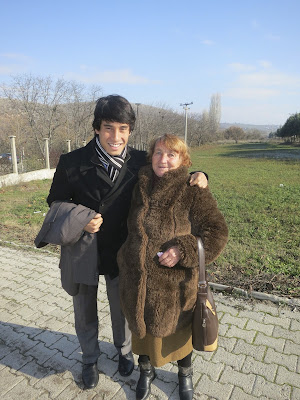 |
| With my host grandmother from Lozovo |
Losing the Lost Generation
As those who lived through the war slowly pass away, I try
to take every opportunity to learn about their experience of such a globally
impactful event. By the end of World War
II, the world would be so divided, and mobility across different spheres would
be so restricted that globalization seen in the 19th and early 20th century
would cease to exist until my generation's time. I enjoy these stories because, even though
each individual, whether soldier or civilian, was simply living his or her
life, each was a unit of either the Axis or Allied side (ok, or lived in a
neutral state). Today people are often
so awed by the military achievements and destruction of the period that they
often forget to ask those who are still living about their individual
experiences. The few accounts that I
have heard impress me with the normalcy in which people lived despite being
surrounded by such destruction. Ultimately,
it impresses me how they view their situations so locally while they shared a
common experience with millions across the globe.


